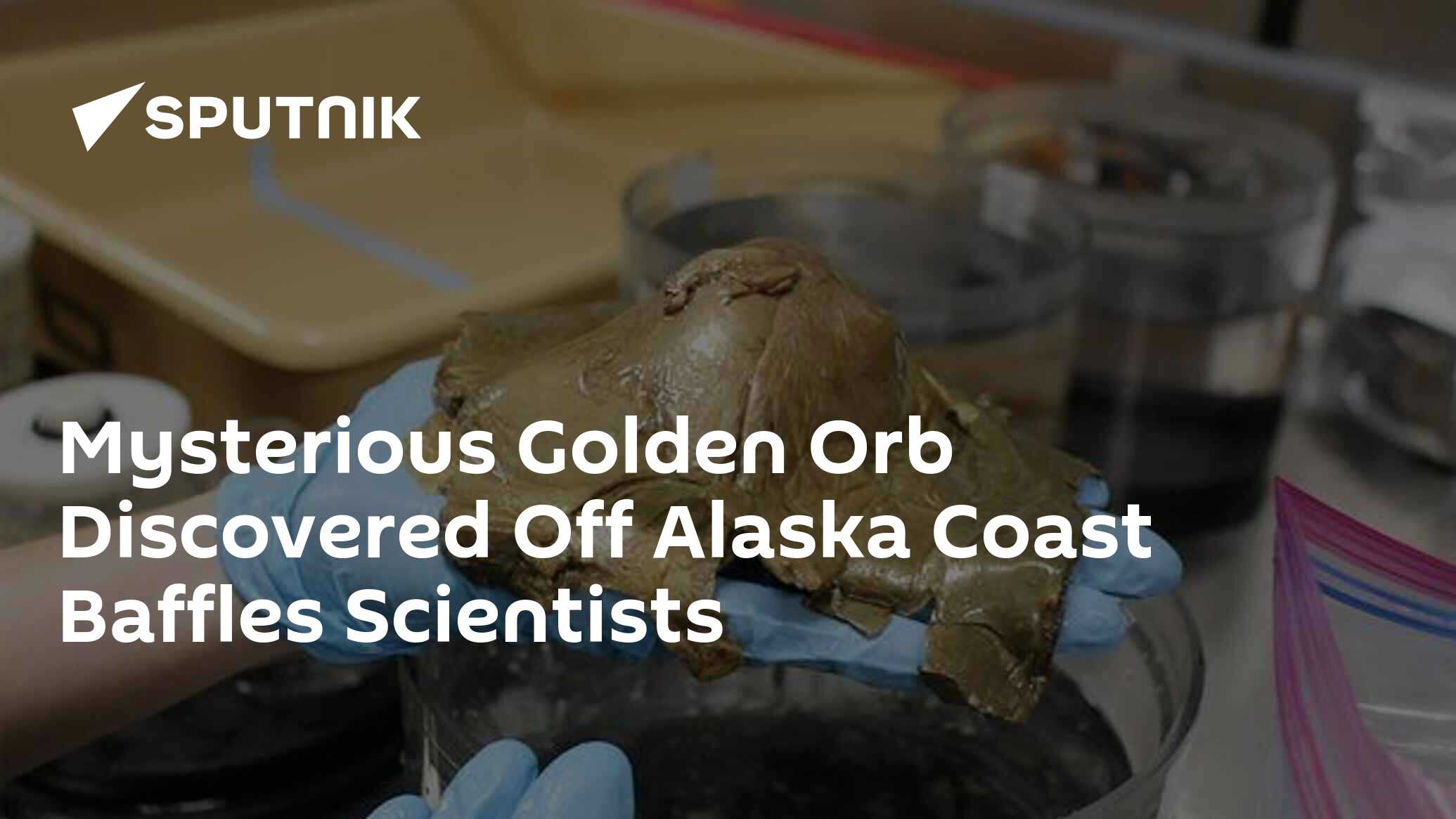
A strange, golden, spherical object found in the deep waters off Alaska stunned researchers and captivated the internet. When the remotely operated vehicle (ROV) captured footage of the gleaming orb nestled on the seafloor, scientists at NOAA (National Oceanic and Atmospheric Administration) didn’t know what to make of it. Smooth, reflective, and perfectly round, it looked more like a sci-fi artifact than a natural marine formation. But after careful analysis, the mystery has been solved—though the answer is almost as bizarre as the speculation it inspired.
This discovery offers more than just a curiosity; it reveals how much of the deep ocean remains unexplored and how unexpected biological phenomena can emerge in extreme environments. The golden orb isn’t alien technology or a lost human object. It’s biological—possibly a previously undocumented species or a rare reproductive structure.
The Discovery: A Glint in the Abyss
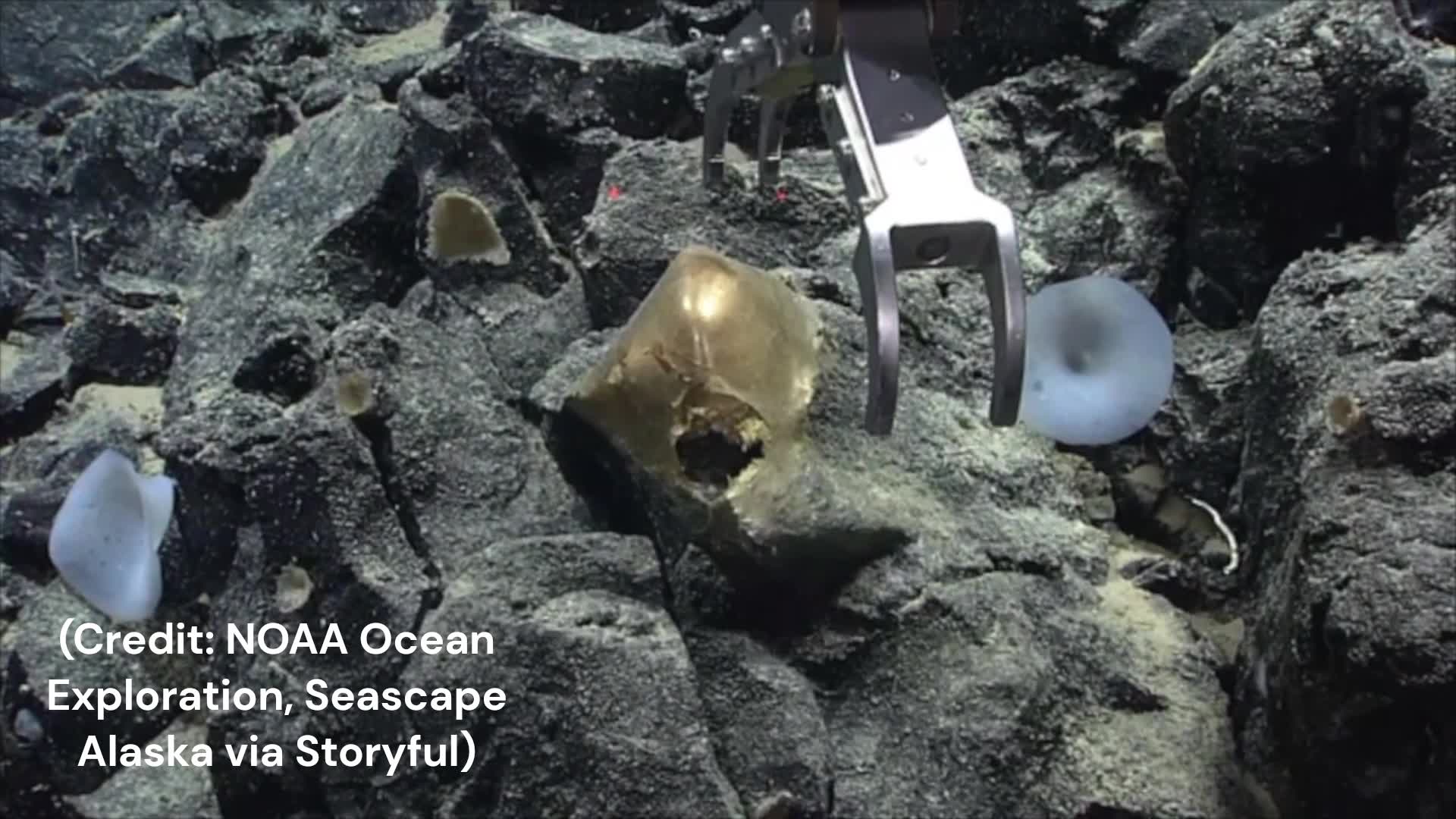
During a 2023 deep-sea mapping expedition off the coast of Alaska, NOAA’s Okeanos Explorer deployed an ROV to survey the uncharted slopes of the Pribilof Canyon. At a depth of roughly 16,000 feet—over three miles down—the robot’s lights glinted off an unusual object.
On screen, it appeared almost metallic: a perfectly round, golden-brown sphere, about the size of a tennis ball, partially buried in the soft sediment. Surrounding it were smaller, similar-looking structures, hinting at a pattern or purpose. The ROV pilot paused. Scientists on the ship above leaned in. No one had seen anything quite like it.
“It was so symmetrical, so isolated, and so clearly not a rock,” said one lead biologist on the mission. “We knew immediately this was either something entirely new—or something we’d never recognized in this context before.”
The team collected a sample using the ROV’s robotic arm and brought it to the surface for analysis.
Initial Theories: From Alien Tech to Geological Anomaly
In the hours after the footage went public, speculation exploded online. Social media erupted with theories:
- Alien probe or communication device – The orb’s symmetry and metallic sheen fueled sci-fi imaginations.
- Lost military object – Some suggested it could be part of a sunken drone or sensor.
- Geological nodule – Deep-sea mineral nodules, often rich in manganese or iron, are common. But their texture and composition didn’t match.
- Egg sac or reproductive structure – A more grounded hypothesis, given its shape and location.
Experts from NOAA and partner institutions quickly ruled out non-biological origins. The surface, while smooth, wasn’t metallic. It was organic—flexible, layered, and composed of proteins and chitin-like compounds.
Scientific Breakthrough: The Orb is Likely a New Species of Deep-Sea Squid Egg Case
After weeks of microscopy, DNA sequencing, and comparative analysis, scientists concluded the golden orb is most likely an egg case—possibly from a previously unknown species of deep-sea squid or octopus.
Unlike shallow-water cephalopods that lay clusters of small eggs, deep-sea species often produce fewer, larger eggs with robust protective casings. These cases must endure extreme pressure, near-freezing temperatures, and total darkness for months or even years.
What made this orb unusual was its: - Perfect sphericity – Rare among known egg cases, which are usually conical or flask-shaped. - Golden, reflective exterior – Likely a result of lipid or protein layers that refract light or deter predators. - Isolation – Found alone, suggesting a single-egg reproductive strategy.
“This could be a brooding strategy we’ve never observed,” said Dr. Emily Callahan, a deep-sea invertebrate biologist at the University of Washington. “Some deep-sea octopuses guard single eggs for years. This orb might contain just one embryo—but one built to survive the harshest conditions.”
Why This Matters for Marine Biology
The deep sea is Earth’s largest habitat, yet less than 20% of it has been mapped in detail. Discoveries like this golden orb underscore how little we know about life in the abyss.
Key implications: - Biodiversity is vastly underestimated – Each expedition reveals new species, especially in understudied regions like the Bering Sea. - Reproductive strategies are more diverse than thought – The orb’s structure suggests evolutionary adaptations we don’t yet understand. - Conservation urgency increases – With deep-sea mining and fishing expanding, unknown species could be lost before they’re even named.
How Deep-Sea Exploration Uncovered the Mystery
NOAA’s mission was part of a broader effort to map offshore ecosystems for conservation and fishery management. The Okeanos Explorer uses high-definition ROVs equipped with sampling arms, 4K cameras, and real-time data streaming.
Technology Behind the Discovery
| Tool | Function |
|---|---|
| Remotely Operated Vehicle (ROV) | Captured live video and collected the sample |
| Multibeam Sonar | Mapped the seafloor to identify dive targets |
| DNA Sequencing Lab (on land) | Analyzed genetic material from the orb |
| Electron Microscopy | Revealed microscopic structure of the shell |
The ability to stream footage live allowed marine biologists worldwide to weigh in during the dive—an example of collaborative “citizen science” in action.
One expert on cephalopod development noted the orb’s resemblance to Graneledone egg cases, deep-sea octopuses known for brooding single eggs. But the golden color and spherical shape were unprecedented.
Challenges in Identifying Deep-Sea Organisms

Identifying a specimen from a single egg case is like solving a puzzle with half the pieces missing. Scientists face several hurdles:
- No parent specimen – Without seeing the adult, classification is guesswork.
- Slow development cycles – Deep-sea embryos can take years to hatch, making lab observation impractical.
- Contamination risks – DNA from microbes on the seafloor can mask the true genetic signature.
Despite these issues, researchers were able to extract mitochondrial DNA that showed distant relation to Bolitaena and Japetella—gelatinous deep-sea octopods.
“This isn’t a perfect match to any known genus,” said Dr. Marcus Lin, a molecular biologist on the team. “It could represent a new branch in the cephalopod tree.”
Common Misconceptions About Deep-Sea Discoveries
The golden orb sparked myths and exaggerations. Let’s clarify some common misunderstandings:
Myth: It’s an alien object. Reality: Every analysis confirms biological, Earth-based origins. No synthetic materials were found.
Myth: Scientists knew what it was immediately. Reality: Initial uncertainty is normal. Most deep-sea discoveries take months to analyze.
Myth: This is the first strange object found in the deep sea. Reality: The ocean floor is full of oddities—glass sponges, sea pigs, faceless fish. But each new find expands our understanding.
Myth: Everything in the deep sea is dangerous. Reality: Most deep-sea organisms are fragile and pose no threat to humans—many can’t even survive at surface pressure.
Why the Deep Sea Remains a Frontier
Even in the 21st century, the deep ocean is as mysterious as outer space. The pressure at 16,000 feet is over 480 times that at sea level. Sunlight doesn’t reach. Temperatures hover near freezing.
Yet life thrives—adapted in extraordinary ways: - Bioluminescence for communication and predation - Slow metabolisms to conserve energy - Unique reproductive strategies, like the golden orb
Alaska’s offshore waters are especially rich due to nutrient upwelling, supporting everything from deep-sea corals to sperm whales. But they’re also vulnerable to climate change and industrial activity.
What’s Next for the Golden Orb?
The sample is now preserved at the Smithsonian’s National Museum of Natural History. Scientists plan to: - Attempt to hatch the egg (if viable) - Compare its structure to other cephalopod cases - Search for similar orbs in archived footage
Meanwhile, NOAA will return to the site in future expeditions, hoping to find the parent organism—a ghostly, slow-moving cephalopod guarding its golden egg in the dark.
The discovery serves as a reminder: the ocean still holds secrets. And sometimes, a simple sphere on the seafloor can challenge what we know about life itself.
Stay Curious—Explore the Unknown
The golden orb off Alaska isn’t just a biological curiosity. It’s a symbol of how much lies beneath the waves—unseen, unstudied, and full of potential. For scientists, it’s a call to keep exploring. For the public, it’s an invitation to look beyond the surface.
Support ocean exploration. Follow NOAA’s live streams. Ask questions. The next mystery could be just a mile beneath the waves.
Frequently Asked Questions
What was the golden orb found off Alaska? It is believed to be a deep-sea cephalopod egg case, possibly from a previously unknown species of squid or octopus.
How deep was the golden orb discovered? It was found at a depth of approximately 16,000 feet (about 4,880 meters) in the Pribilof Canyon.
Who discovered the golden orb? NOAA’s Okeanos Explorer mission team discovered it during a deep-sea mapping expedition.
Is the golden orb dangerous? No. It is a biological structure with no harmful properties. It poses no threat to humans.
Could the golden orb be of alien origin? No scientific evidence supports extraterrestrial origins. All analysis indicates it’s a natural, Earth-based organism.
Has the species been named yet? Not officially. Scientists are still analyzing DNA and structure to determine if it represents a new species.
Can the egg still hatch? It’s unlikely after the pressure and temperature changes during recovery, but researchers are assessing viability.
FAQ
What should you look for in Scientists Identify Mysterious Golden Orb Off Alaska’s Coast? Focus on relevance, practical value, and how well the solution matches real user intent.
Is Scientists Identify Mysterious Golden Orb Off Alaska’s Coast suitable for beginners? That depends on the workflow, but a clear step-by-step approach usually makes it easier to start.
How do you compare options around Scientists Identify Mysterious Golden Orb Off Alaska’s Coast? Compare features, trust signals, limitations, pricing, and ease of implementation.
What mistakes should you avoid? Avoid generic choices, weak validation, and decisions based only on marketing claims.
What is the next best step? Shortlist the most relevant options, validate them quickly, and refine from real-world results.